
You have probably heard of heart rate training zones, and how elite endurance athletes and, more recently, a growing number of recreational athletes use them to guide their training.
This post explains why they matter for your training and how each zone pushes your body in a different direction.

What are heart rate zones?
Heart rate training zones reflect your body’s metabolic state at different training intensities. They are heart rate ranges (for example, 123 to 142 beats per minute), each one corresponding to an exercise intensity where your body responds metabolically in a specific way. Two factors determine the metabolic state of your body in each zone:
- The fuel mixture used (the balance between fats and carbohydrates).
- The physical traits your body develops when training in that zone.
For example, when training in zone 2, your body burns the most fat and improves its fat-burning capability at the fastest rate.
What is your body’s fuel mix, and how does it determine training zones?
During exercise, your body burns a mixture of fats and carbohydrates to release the energy (calories) it needs to move. Fat releases more energy than carbs when burnt (9 kcal per gram of fat versus 4 kcal per gram of carbs) but burns more slowly, which makes it suited to low exercise intensities where the rate of energy demand is low. Carbohydrates burn faster and can therefore support higher intensities where the rate of energy demand is larger. The mix of fats and carbohydrates your body is using shows up in the balance of oxygen and carbon dioxide in your breath, and is measured with a metabolic analyzer such as PNOĒ. Figure 1 shows how fat and carbohydrate burn change as intensity increases during a treadmill test.
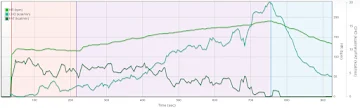
Because that measurement requires a mask, information about your fuel usage is almost impossible to collect during everyday training. So we use heart rate as a proxy to estimate fuel usage and metabolic state. A metabolic test measures heart rate alongside the fat-carbohydrate mix, so the correlation between the two can be established. We call this getting your personalized training zones. It is worth noting that the correlation between heart rate and fuel mix depends on the type of exercise. You might burn 30% fat and 70% carbs at 140 beats per minute when running, but only 15% fat and 85% carbs at 140 beats per minute when cycling.
How many training zones are there, and what does each one train?
The five-zone system is the most widely used. It captures the real differences in metabolic state while staying practical for everyday use. Each zone has a different purpose because it drives a different adaptation.
Zone 1
Warm-up and active recovery intensity, meaning recovering from hard exercise while still moving.
Zone 2
Zone 2 training develops mitochondrial function and improves fat-burning efficiency. It is highly recommended for long-range endurance sports and for people managing metabolic syndrome such as type 2 diabetes. Better mitochondrial function also supports recovery, so you bounce back faster after intense sessions.
Zone 3
Zone 3 training strengthens the pulmonary muscles and improves cardiovascular function. Its moderate intensity gives the heart and lungs a strong stimulus without being exhausting, which makes it a good fit for anyone working around a lung or heart issue.
Zone 4
Zone 4 training improves your VO2 max and your ability to hold high intensities for longer by improving lactate shuttling. Lactate is a by-product of anaerobic metabolism that your muscles can also use as fuel. As long as your body clears fatigue by-products faster than it produces them, the intensity stays sustainable. The better your lactate shuttling, the longer you can hold a hard pace.
Zone 5
Zone 5 training improves VO2 max and peak power output, such as top speed or peak cycling wattage. This intensity is sustainable for 60 to 120 seconds and demands your maximum effort.
Why should I care about training zones?
Regardless of age, gender or fitness level, everyone has one or more systems limiting their fitness or health. Targeting those limitations effectively takes precision: focusing your cardio and interval work on the zone or zones that will bring the adaptation you need.
So how can our gym in Grande Prairie help?
The PNOE device measures the oxygen you use at rest and during activity to work out how many calories you need and which substrate, carbohydrate or fat, you are burning. There are a few tests PNOE can deliver:
- Resting Metabolic Rate (RMR): the calories you need to maintain your weight and health at rest.
- Metabolic Efficiency: the calories you need to maintain your weight and health during activity.
- VO2 Max: the maximum amount of oxygen your body can use during exercise.
The PNOE metabolic analyzer gives gold-standard accuracy in determining your training zones, along with a plan that puts them to work.
Understanding how your body responds metabolically, and building your program around your metabolism, is a foundational step toward getting more out of every workout and reaching your health or performance goals faster and with less wasted effort.
Our personal trainers can build a training plan around your goals, whether that is better blood sugar control, a boxing competition, or the Death Race. Metabolic and body composition testing is available through our partners at Edge Nutrition & Performance.
Start with a free intro consultation
Once you understand your metabolism, our coaches can write a program tailored to you that gets results in less time. The first step is a free twenty-minute intro consultation: tell us where you are, where you want to be, and what has not worked before.